
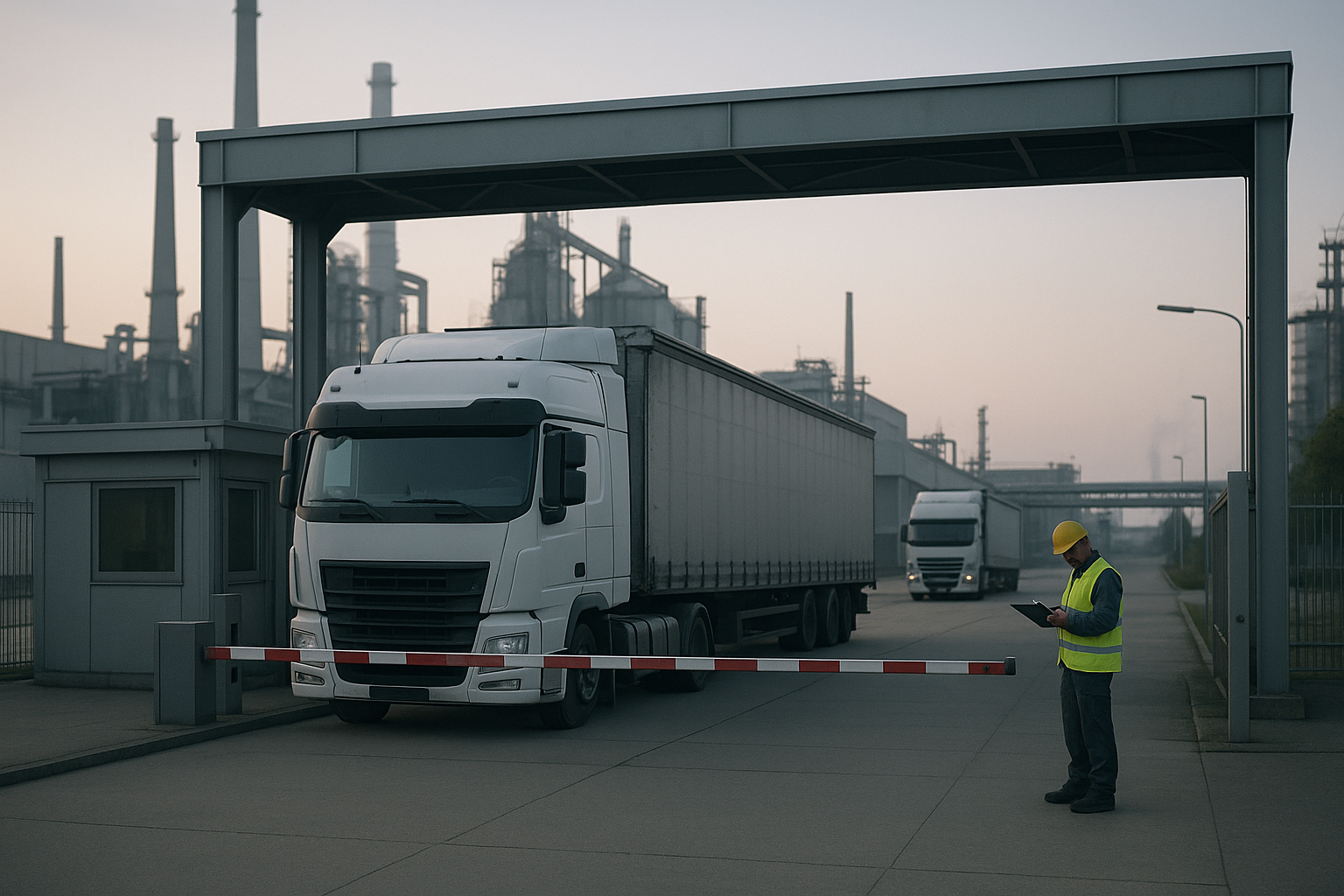
Consider this question carefully: How many of your inbound suppliers do not arrange haulage themselves, but instead hand that responsibility to your procurement, planning or directly to you? And how many arrange it themselves — on an FCA basis, free to the haulier of their choice, with a driver you’ve never met? Your answer to this determines how much actual control you have over your own goods-in operation.
The silent majority: FCA deliveries with no portal access
In German plants, industry estimates put 40 to 70 per cent of all inbound deliveries on an FCA basis. This means: the supplier has engaged the haulier, the haulier is working at their own expense, and the driver is someone who has never encountered your time-window system — and often cannot.
Time-window portals require someone to book a slot. Usually that’s the haulier. But if the haulier isn’t registered in the system, has no login details, or is put off by the booking fee — from around one euro per booking, acceptance drops noticeably, according to a Cargoclix study — the slot stays empty. The vehicle arrives anyway. Just whenever it suits.
This isn’t a failure of the portal. It’s a structural problem: The portal only covers hauliers you can invite. FCA means: you’re not inviting anyone — your supplier is.
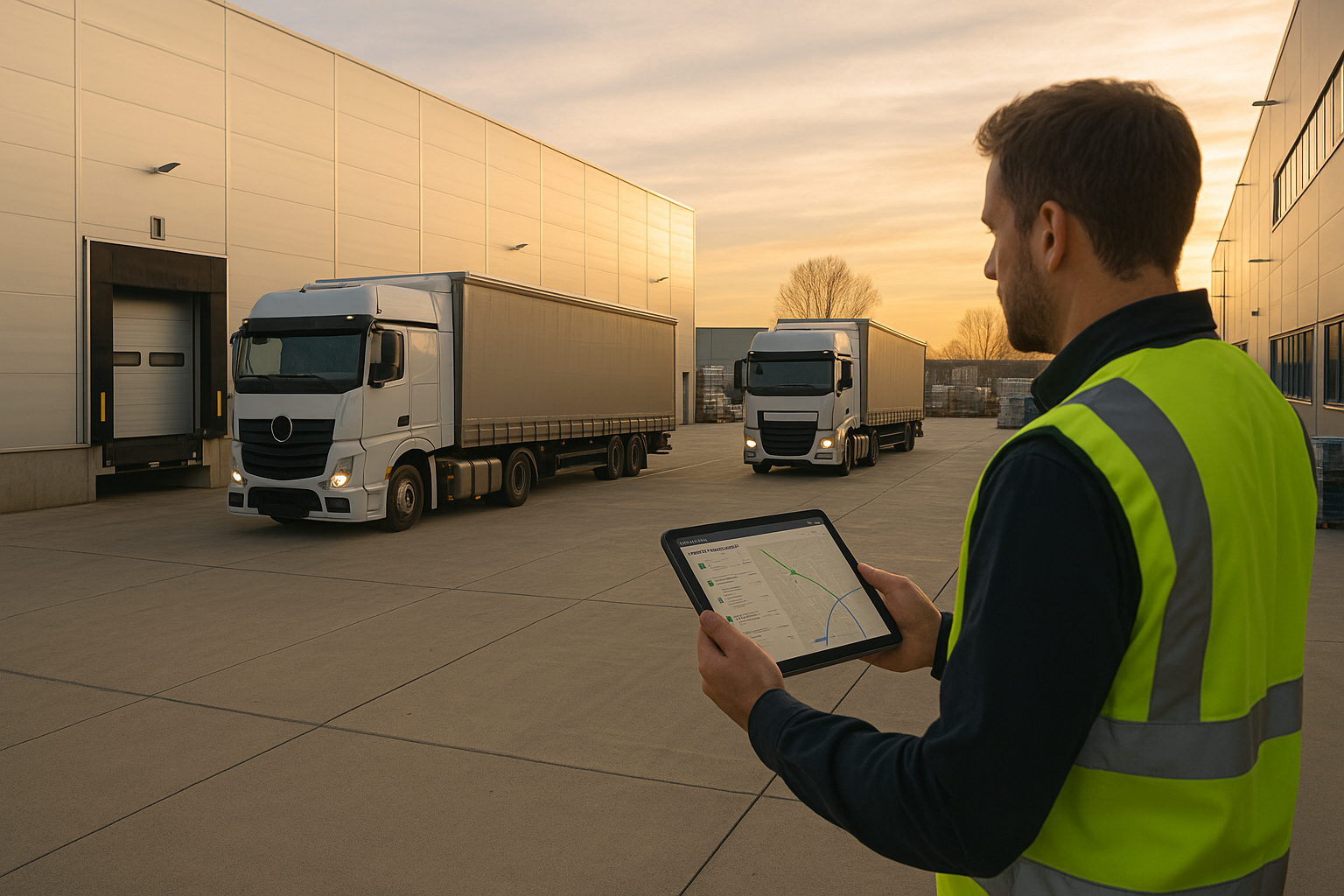
What your yard doesn’t know — and can’t see
This is where the real problem lies. It’s not about punctuality. It’s about visibility: Who’s coming, and when? What vehicle are they in? Do they have cargo that’s urgently needed, or is it routine material with no deadline?
The typical flow in a mid-sized plant looks like this: a time-window was booked for 09:30 — by someone. The driver doesn’t know about the slot because the haulier didn’t pass it on. He starts when his job is done, navigates to the gate, checks in at the security gate and waits. Dispatch only finds out he’s there when a queue forms at the gate or the security guard rings through.
By then your yard already has three other vehicles — two of which arrived unannounced, and one waiting with cargo while the forklift is somewhere else.
This isn’t an unusual day. This is Wednesday morning.
The subcontractor chain as an amplifier
What structurally worsens the FCA blind spot: most larger hauliers don’t drive themselves. They subcontract — sometimes to subcontractors of subcontractors. In the end, a driver is sitting in a vehicle that’s been commissioned through two layers. The original haulier often doesn’t have the driver’s contact details in real time. The subcontractor does, but doesn’t communicate with your plant.
This means: between the moment your supplier engages the haulier and the moment the driver pulls up to your gate, there’s a chain of three to four players — none of whom you speak to directly.
The driver is the last link in that chain. And he’s the only one who actually knows when he’ll arrive at your gate.
Slot ≠ Arrival: the equation that was never right
Time-windows solve a different problem than the one unfolding on your yard every day. They solve the planning problem: when should someone arrive? They don’t solve the control problem: when will someone actually arrive?
Between booked slot and actual arrival there’s typically a deviation of 20 to 90 minutes — sometimes earlier, sometimes later. This isn’t a guess pulled from thin air: it’s what every dispatcher knows who takes calls asking “Can I come an hour earlier?” or “I’m stuck in traffic, I’ll be there at eleven.”
These calls land with your dispatcher. They type the new time into a spreadsheet, send an email to goods-in, hope the forklift is still free.
Do the maths: if a plant receives 30 deliveries a day and one in five triggers an active update — six calls at ten minutes each, plus documentation and handover — that’s an hour of dispatch time daily. At 250 working days a year and a labour rate of €40 per hour: €10,000 a year spent just taking messages that should never have needed passing on.
That’s the floor. In plants with higher volume or less digitally-engaged supplier bases, the maths look different.
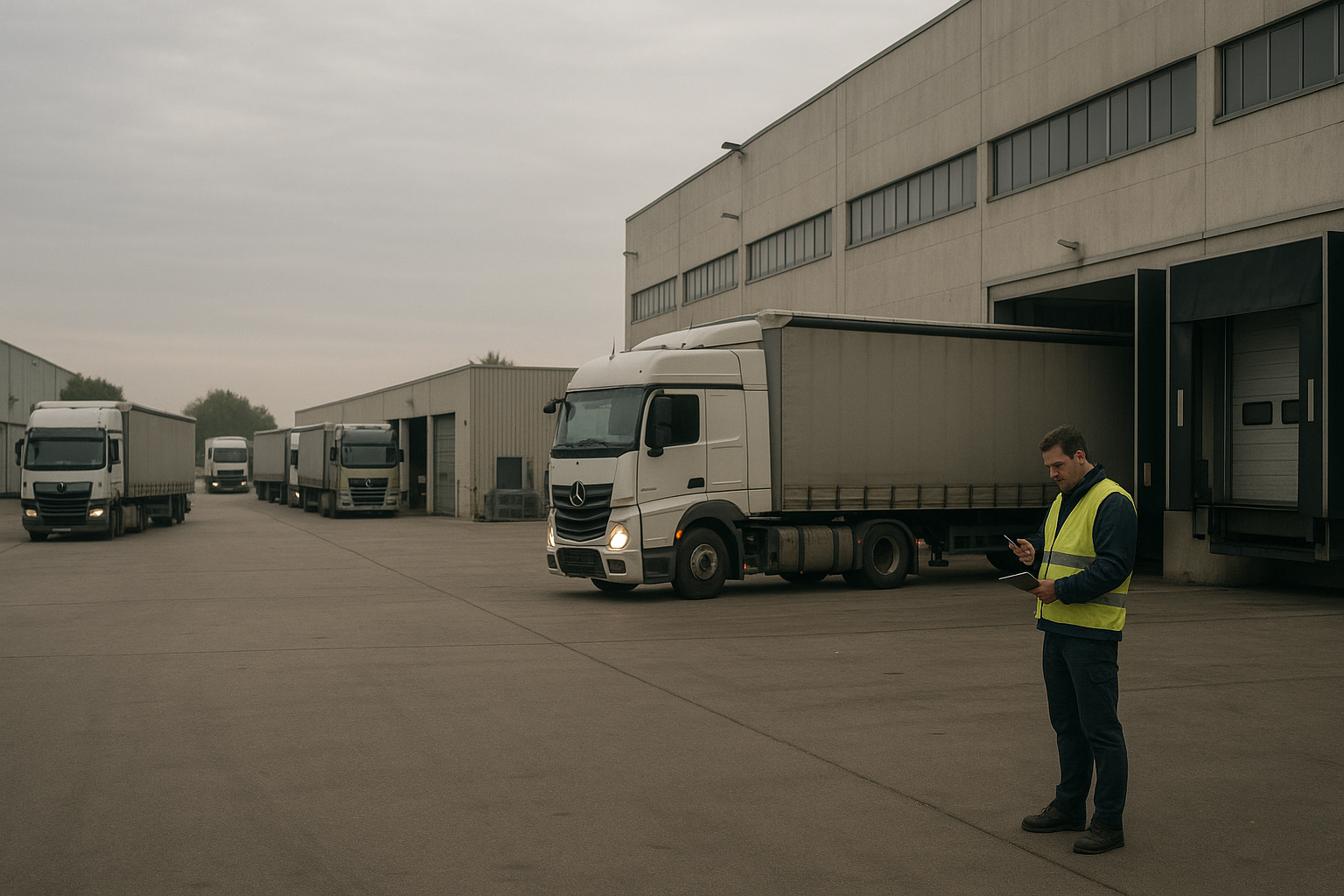
Why “stricter rules” doesn’t solve the problem
The standard response to poor punctuality in goods-in: you send a supplier circular. “Please deliver only within your booked time-window.” You write it into the supplier contract. You threaten rejection.
It rarely works. Not because suppliers are malicious, but because they can’t control the chain that you can’t control either. The supplier engages the haulier. The haulier engages the subcontractor. The subcontractor briefs the driver at six in the morning. The driver sets off. No one in that chain has a reason to check your time-window portal — and many simply have no access to it.
“We tightened the rules. The carriers know them — but the driver behind the wheel doesn’t.”
Logistics managers often say this about themselves when pushed. It’s not a statement about bad suppliers. It’s a statement about a system that fails to get information to the right place.
The vacuum between order placement and gate entry
Between the moment your supplier engages the haulier and the moment that vehicle passes your gate, there’s typically a window of 12 to 48 hours. From your perspective during that time: nothing happens.
You see no progress. You don’t know if the driver has already loaded, if he’s still waiting for customs clearance, if the haulier has deployed a different driver than originally planned. The supplier sometimes knows, but often doesn’t either — because after placing the order they lose visibility into the operational logistics themselves.
Those 12 to 48 hours are the structural vacuum that no slot system closes. The portal knows the slot. It doesn’t know reality.
Up to 80 per cent of advance notices that reach German plants arrive as Excel or email — a static snapshot that can be out of date by the time it lands.
What’s possible with the driver
97 per cent of lorry drivers have their own smartphone. That’s not an extrapolation — it’s lived reality at every plant gate. The driver navigates with his phone, receives messages, runs his day digitally.
He’s reachable. He’s the only link in the chain who actually knows where he is right now.
The problem isn’t the driver. The problem is that no one from your plant talks to him yet — because the chain is too long, because you don’t have his number, because you don’t know who’s actually driving today.
Heylog automatically sends the driver a WhatsApp. He confirms his ETA. You see it in your dashboard. No phone call, no app, no portal login. The driver gets in touch with you before he arrives — regardless of who arranged the haulage and whether a slot was booked or not.
What this means for your FCA portion
If 40 to 70 per cent of your inbound runs on FCA, that’s the group for which you currently have no advance information. Not because you don’t want it. Because the information chain systematically excludes that group.
The point isn’t to abolish the slot system. Slots serve a planning function — they make sense. But they’re not a control tool. They’re a statement of intent.
The question isn’t: “How do we get more hauliers into the portal?” It’s: “How do we ensure that for every delivery — slot or no slot, FCA or DDP, familiar carrier or subcontractor — we know what’s coming at least 12 hours before arrival?”
An open question to finish
Do you know how many of yesterday’s deliveries came from a subcontractor you’d never met before? And on how many did you have more than two hours’ notice of the actual arrival time?
If the answer to both is “I’m not sure” — that’s not your failure. It’s the logical consequence of a system that ends with the driver without ever including him.
What would change if you knew this for every FCA inbound delivery?
Frequently asked questions
What does FCA inbound management mean for manufacturing facilities?
With FCA inbound management, your suppliers independently arrange haulage. The plant has no direct access to the carrier booked and often receives no advance ETA. Industry estimates show 40–70 % of all DACH inbound deliveries run on an FCA basis — the biggest blind spot in goods-in for many plants.
Why does a time-window portal often fail with FCA deliveries?
Time-window portals require hauliers to register and book a slot. With FCA deliveries, suppliers engage their own hauliers, who frequently lack portal access. According to a Cargoclix study, haulier acceptance drops noticeably from around €1 booking fee — resulting in unplanned arrivals.
How can a plant know the arrival time of FCA drivers early?
Since 97 % of lorry drivers own a smartphone, direct contact via messenger is possible. If the driver automatically receives a message and confirms his ETA before reaching the plant, manual calls disappear — and dispatch has advance notice for every delivery, regardless of who originally booked the haulage.