
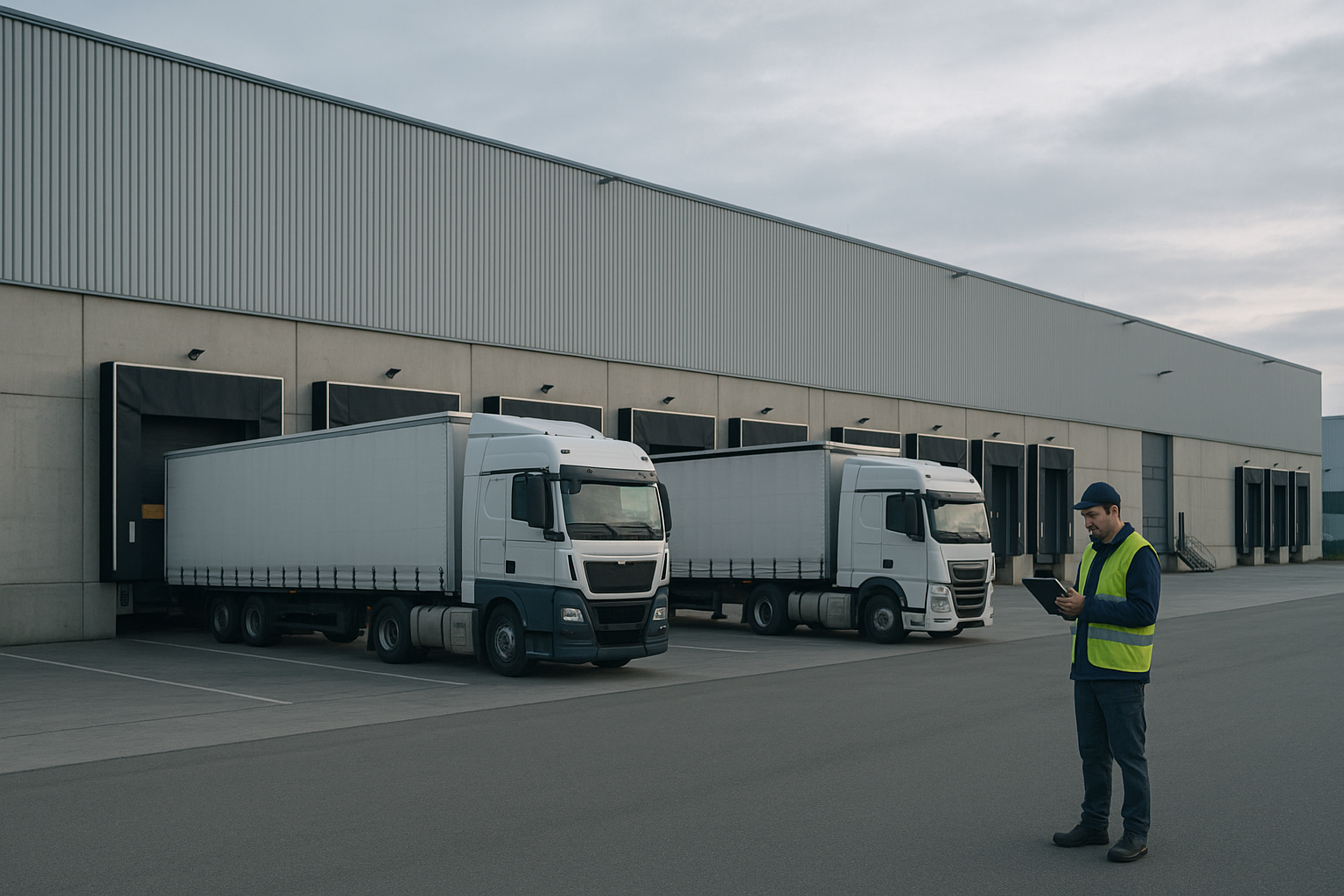
Three hours of waiting time at the gate costs a haulier around €180. The question isn’t whether that’s true — it is. The question is who pays for it in the end. And the honest answer is: you. Priced into the next freight rate, factored into the spot market surcharge, sometimes as an explicit dwell fee on the invoice. Dwell time at goods-in is not a haulier’s problem. It’s a cost problem for the consignee — and it begins not at the gate, but a good 24 hours earlier.
What a time-window really controls — and what it doesn’t
A time-window system books a point in time. It co-ordinates expectation, not arrival. The driver who is supposed to be at your gate at 09:30 didn’t book this slot themselves in most cases. It was entered by the haulier’s dispatcher, often the day before or even two days prior. Whatever happens between booking and actual arrival — route changes, a delayed upstream drop-off point, a different driver than planned, a vehicle swap at a subcontractor — no time-window portal that allocated a slot the day before is capturing any of that.
The time-window controls intent, not reality.
This is not a criticism of time-window systems — they do useful work on the basic structure. An industry study does show, however, that around 50 % of users couldn’t measure a genuine process improvement. What’s missing is the phase beforehand.
The 12–48 hours that no software covers
Picture a typical Tuesday morning at goods-in: plant opens at 06:00, first time-window at 06:30. By 08:00 four docks are scheduled. What actually happens: two vehicles arrive on time, one doesn’t show at all, one appears 70 minutes early. The dispatcher tries at 06:45 to find out by phone where vehicle three is. The number in the manifest belongs to the dispatcher at the freight company that placed the order — not the driver who’s currently on the motorway. Subcontractor, second tier. No answer.
This isn’t an exception. It’s the norm.
“Between the moment the time-window is booked and the moment the driver pulls onto your site, everything that matters happens — and you see none of it.”
In Germany, up to 80 % of all pre-notices are still running via Excel or email. This means: even where notification does happen, it’s a document — not a real-time signal. The logistics director reads an announcement, not a current location.
Add to that a structural problem that cuts especially deep in inbound: 40 to 70 % of DACH inbound deliveries run on FCA terms. That means the supplier commissions the haulier, not you. The haulier may have portal access, the subcontractor doesn’t. And the driver who actually moves the freight has the least information in the chain — and the greatest impact on your dock plan.
What dwell time really costs — the calculation nobody wants to do
Dwell fee discussions are usually treated as a freight issue. That’s too narrow.
Take a manufacturing plant with 60 inbound deliveries per day, 250 working days a year. A realistic proportion of 20 % of deliveries arrives with a deviation of more than 30 minutes from the booked time-window — that’s 12 deliveries daily that destabilise your plan.
Each of these deliveries incurs internal overhead:
- Locating the vehicle or dispatcher: 8–15 minutes of dispatcher time
- Reprogramming dock assignment: 5–10 minutes
- Communicating with the warehouse (shifting unload teams): 5–10 minutes
Assuming each unexpected deviation costs 20 minutes of internal co-ordination time at an hourly rate of €35:
12 deliveries × 20 minutes × €35/hour × 250 days = €35,000 internal co-ordination overhead per year
That’s the conservative estimate. Not included: idle time for forklift teams waiting for a vehicle that never comes. Not included: overtime costs from vehicles arriving late and unloading falling outside regular shift hours. Not included: the effect on your freight price.
And that last point is the most uncomfortable one.
Hauliers price risk. If your plant is known as difficult — long waiting times, unreliable dock planning, poor accessibility — then that risk gets factored in. Not in a formal conversation, but tacitly. The next annual contract lands 3–5 % above market. The spot market factor for your site is higher than for comparable locations. Some carriers actively avoid your plant — and you’ll eventually see that reflected in Google Maps reviews that drivers leave before deciding whether they’ll come back.
Dwell time at goods-in is a reputation problem — even if you’ve never looked at it that way.
Why stricter time-window rules don’t solve the problem
The most common reaction to chaotic peak-hour situations: tighten the rules. Later delivery windows, tighter time-windows, penalties for no-shows.
That addresses the symptom, not the cause.
The driver arriving 70 minutes early often doesn’t know he’s early. He doesn’t have current time-window information. His client gave him a delivery note and an address. The time-window? The haulier booked it. Whether the driver knows about it — uncertain.
Stricter rules hit the wrong target: the driver or the subcontractor who has the least influence over the booking chain. The actual cause — missing communication in the hours before arrival — goes unaddressed.
97 % of drivers have their own smartphone. They’re reachable. Most systems simply don’t tap into that accessibility.
The lever sits before the gate, not behind it
The logistics directors who systematically reduce dwell time at goods-in don’t work on stricter rules. They work on the window between time-window booking and arrival.
Concretely, that means:
- Knowing when a vehicle actually departs
- Getting an ETA based on real position — not on a booking made two days ago
- Responding early enough to deviation so you can replan docks before congestion forms at the gate
- Speaking directly to the driver — not routing through the haulier’s dispatcher as a middleman
That sounds like more work. It’s actually less: if you’re informed early, you don’t make phone calls. If you can replan before the vehicle moves, you have no surprises in the morning.
The peak-hour rush — roughly 40 % of daily deliveries in the first 90 minutes after plant opening — can’t be eliminated. But it can be planned if the information arrives early enough.
What pre-arrival management means in practice
Heylog addresses exactly this phase: the hours before the gate. The driver gets an automatic WhatsApp — no app download, no portal login. He checks in before he arrives. You get an ETA without making a single call. What appears in your dashboard isn’t a booking from yesterday — it’s the live update from the person who’s driving right now.
That changes nothing about the time-window system you already use. It closes the gap beforehand.
The real question
Your time-window system shows you who’s supposed to come. But do you know who’s actually driving right now — and when they’ll arrive at your site?
What proportion of your deliveries do you only find out about when they’re at the gate?
Frequently Asked Questions
How does dwell time at goods-in really develop?
Dwell time at goods-in doesn’t occur at the gate, but in the 12 to 48 hours beforehand. Vehicle swaps, route changes, or a delayed upstream drop-off point shift the actual arrival time – without the booked time-window learning about it. Without real-time information about the driver during this phase, you only react once the vehicle is already waiting.
What does dwell time at goods-in cost a manufacturing plant per year?
At a plant with 60 inbound deliveries daily and a realistic deviation rate of 20 %, around 12 unplanned co-ordination events occur each day. At 20 minutes of internal effort per case and €35/hour, that calculates to roughly €35,000 annual co-ordination overhead — and that’s before idle time for unload teams and freight price effects.
Why do stricter time-window rules often fail to address dwell time?
Stricter rules tackle the symptom, not the root cause. The driver arriving early or late often has no direct access to the time-window information – it sits with the dispatcher at the freight company that placed the order. Missing communication in the hours before arrival stays unaddressed through rule tightening. More effective is pre-arrival management that involves the driver directly before the journey.