

What does one hour of dwell time on your yard really cost? Most logistics directors offer a figure off the top of their head. Sometimes the direction is right. But worked through — truly worked through, with all seven line items — almost nobody has done it. This is not criticism. It is a structural problem: the most expensive hours on your yard appear in no cost centre.
Why hidden yard costs remain so stubbornly invisible
Finance records what generates invoices. A fork-lift driver waiting 40 minutes because the dock is blocked generates no invoice. A dispatcher making 18 calls daily to clarify arrival times generates no separate booking. Overtime that arises Monday morning because 40 % of all day deliveries roll in between 06:30 and 08:00 — those land on the payroll account, not under “yard coordination”.
The result: budget discussions about yard coordination fail regularly not from lack of insight, but from lack of numbers. And whoever lacks a number gets no budget.
This article exposes seven cost positions. None of them are invented. All of them are real in manufacturing plants — they are simply rarely gathered in the same report.
Line item 1: Dwell time — the costs your freight price already contains
Hauliers factor dwell time into their quotes. Not openly, not as a line on the invoice — but it is there. A plant known for drivers waiting regularly 60 to 90 minutes pays for it through the freight price. Not once, but every time you place an order.
How much? It varies sharply by lane and volume, but a flat dwell-time surcharge of 8 to 15 % on the base price is not uncommon in the industry — it just rarely goes by that name. It is called “direct delivery surcharge” or “handling allowance” or does not appear explicitly at all, because it is already priced into the driver’s hourly rate.
The micro-calculation for your plant:
Take your daily inbound shipments. Estimate conservatively how many end with more than 45 minutes wait time. Multiply by a 10 % surcharge on average freight price. At 30 deliveries per day, an average price of €280, and 20 % of trips with wait time, that is roughly €1,680 per week — silently, without invoice, without a cost centre.
Line item 2: Dispatch calls — staff time nobody counts
Up to 80 % of pre-advice notifications in German plants still run via spreadsheet or email. What that means: someone must actively check. Where is the lorry? Will it arrive today? Does the driver have dock information? Can goods be prepared?
A typical dispatcher makes — depending on plant size and daily volume — between 15 and 25 such clarification calls per day. Four minutes per call, that is realistic, perhaps even optimistic. At an hourly rate of €35 (full cost) and 250 working days:
20 calls × 4 min = 80 min/day × 250 days = 333 hours × €35/h = €11,655 per year
This is a role that does not show up in headcount planning because it is split across ten shoulders. And because nobody books these minutes as “yard coordination”.
Line item 3: Dock blockade — the silent production delay
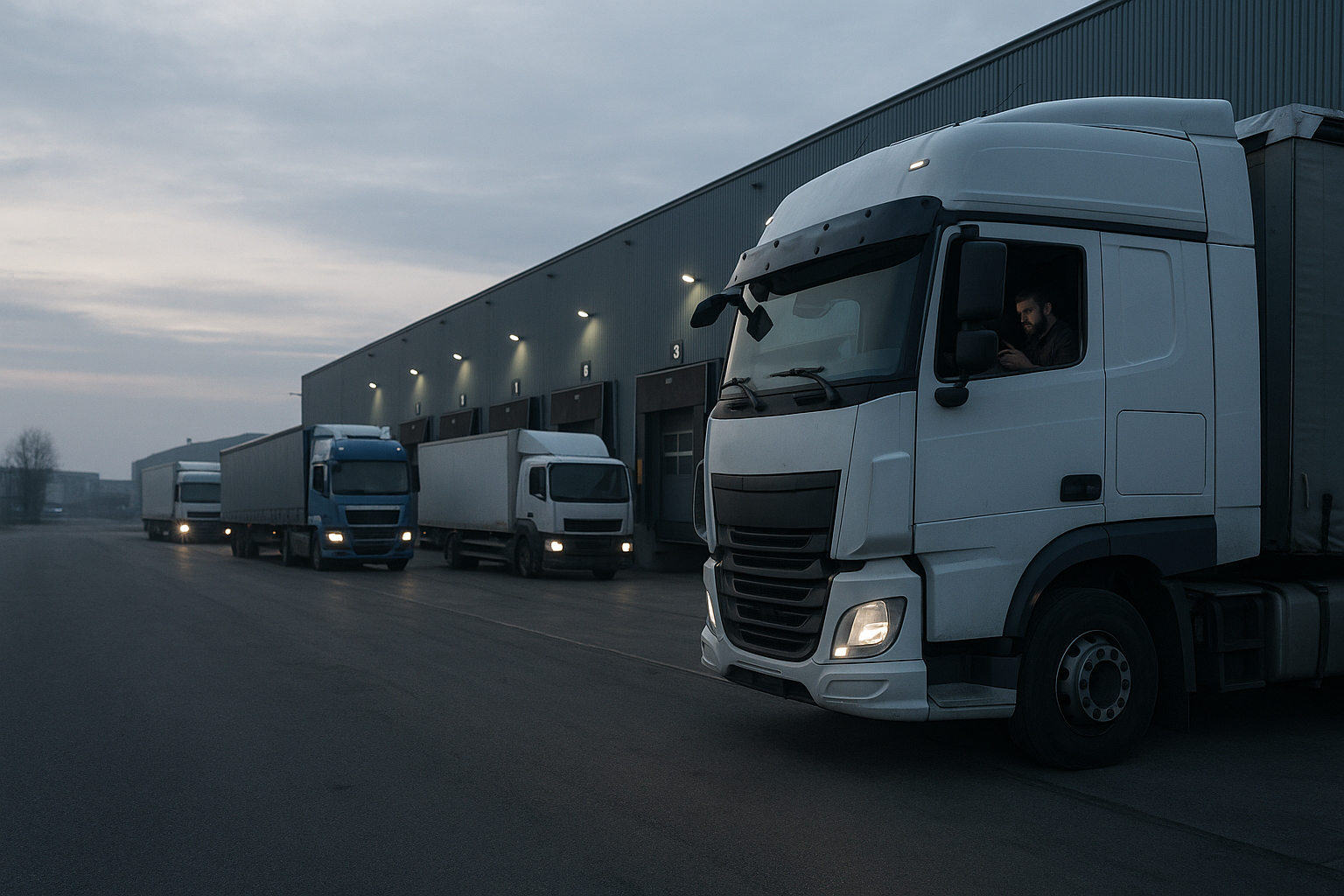
One lorry sits 70 minutes at dock 3. Dock 3 is blocked. The next lorry — the one with the parts the line needs at 09:00 — waits at dock 4 because dock 3 would normally be correct, but it is occupied. Someone decides ad hoc. Someone reorganises.
What really happens in this hour? In plants with takt production, a delayed material arrival can bring a line to a stop for 15 to 30 minutes. In automotive supply, in pharma manufacturing, in food production — anywhere just-in-time is not a phrase but an operating mode, this half hour has a concrete cost. It appears under “production downtime”, sometimes under “maintenance” (if machines run whilst idle), rarely under “yard coordination”.
The connection between yard chaos and production delay is real. It is simply not named that way.
Line item 4: Carrier reputation — what hauliers tell each other about your plant
Drivers talk. Dispatchers at haulage firms talk. Google Maps now hosts thousands of ratings for loading points — many from drivers who waited there. What is written there has consequences.
If your plant is known as a “difficult location” — long waits, poor communication, unreliable clearing — hauliers respond with higher spot-market quotes, lower priority in capacity crunches, less willingness to arrange flexible scheduling.
How much that costs cannot be pinned down exactly. But the mechanism is known: carrier scoring systems in haulage firms note where drivers are treated poorly or where loading times are unpredictable. Your yard has a reputation. The question is only whether you know it.
Line item 5: Peak overtime — Monday morning as a cost driver
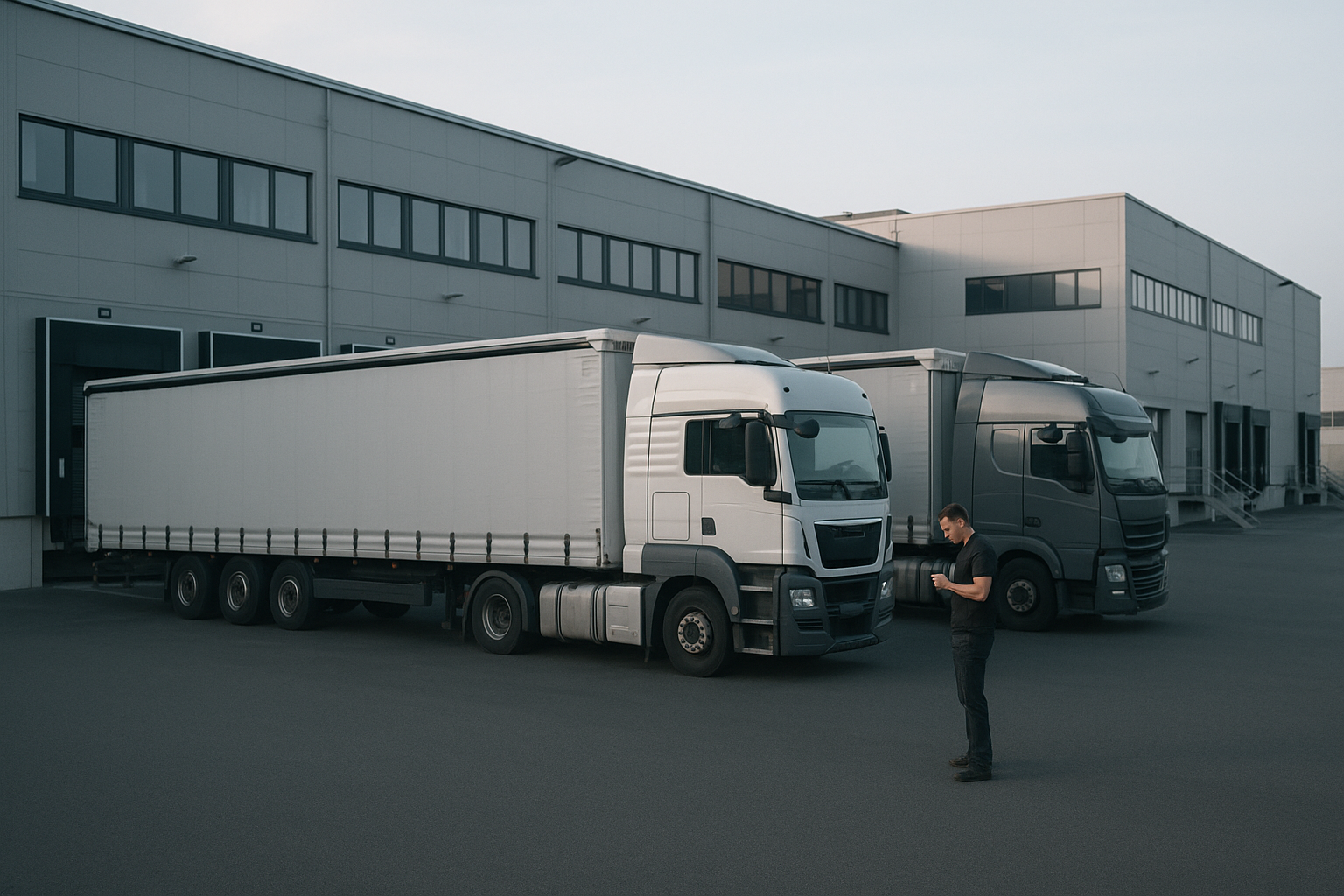
Around 40 % of all daily inbound deliveries roll into the yard in the first 90 minutes after plant opening. This figure is observable across industries and has a simple cause: drivers want to unload early to complete their run. But the plant at 06:30 is not set up for 40 % of the day’s volume.
What follows: overtime for fork-lift operators and goods-in staff, spontaneous task reorganisation, overloaded gatehouse, yard congestion. And at month-end, overtime premiums booked under “personnel costs” — with no link to the yard, no link to the morning peak.
Quick calculation: 4 staff work morning peak overtime of 45 minutes 3 days per week. At €35/h full cost and 50 % overtime premium: 4 × 0.75h × 1.5 × €35 × 150 days = €23,625 per year. In no yard-cost analysis. In payroll: unremarkable.
Line item 6: Errors from chaos — what returns really cost
Chaos carries its own error rate. When docks are assigned wrongly, when delivery notes go unchecked in the rush, when the wrong pallet is loaded because nobody had time to verify the delivery note number — returns happen.
A goods-in return costs — depending on industry and product — between €80 and €350 to process: reversal, return transport, reorder, communication with supplier and haulier. In plants with 5 to 10 goods-in errors monthly, some traceable to poor yard coordination, that is a mid-four-figure sum annually — also without a cost centre.
Line item 7: Documentation effort — what remains after the lorry
When a lorry arrives 90 minutes late, what follows is rework: who was responsible? Was it the haulier, the driver, traffic? Does a demurrage invoice need checking? What was unloaded when?
Without systematic arrival logging, these questions flow via email, phone, handwritten gatehouse notes. One employee spends 20 to 40 minutes on follow-ups that have no operational impact — only documentation, usually incomplete. In plants with frequent deviations, these minutes add up to genuine hours per week.
What this adds up to
Set all seven line items side by side. Not as an exact figure — that would be misleading, as every plant is different. But as a structural observation:
- Dwell-time surcharges in freight prices
- Dispatch staff time for clarification calls
- Production delay from dock blockades
- Spot-market surcharges from poor carrier reputation
- Morning peak overtime
- Returns and error costs from chaos
- Documentation effort without system support
None of these line items has its own cost centre. All of them are paid nonetheless.
A plant with 40 daily inbound shipments and moderate wait times can alone from line items 1, 2 and 5 reach €40,000 to €70,000 in annual extra costs — depending on freight volume, staffing structure and peak behaviour. That is not a Heylog figure. That is industry maths.
What becomes possible when arrivals are controllable
The key to managing several of these costs lies not on the yard itself, but in the hours before. If you know when a lorry will actually arrive — not by slot, but by driver — you can assign docks sensibly, prepare goods-in and flatten the morning peak.
Heylog automatically sends the driver a WhatsApp. He confirms his ETA. You see it in the dashboard. No call, no app, no portal.
This does not resolve all seven line items at once. But it turns reactive yard management into something that feels like control — and changes which costs can arise at all.
The question that remains
Which of the seven line items do not appear in any of your reports — and how much would you estimate that total at if you calculated it properly for the first time today?
Frequently asked questions
What are typical hidden yard costs in manufacturing plants?
Hidden yard costs include dwell-time surcharges in freight prices, staff time for clarification calls, production delay from dock blockades and morning peak overtime. These line items appear in no separate cost centre, yet in many plants they total €40,000 to €70,000 annually.
How do dwell-time surcharges arise in freight prices and how large are they?
Hauliers build known wait times at plant locations into their freight prices — often as flat handling or direct-delivery surcharges. In the industry, surcharges of 8 to 15 % on base price are common, without these being itemised as dwell-time charges.
How can the morning goods-in peak be measured concretely?
Industry observation shows that around 40 % of all daily inbound shipments arrive in the first 90 minutes after plant opening. You can measure this yourself by analysing gatehouse entries or dock protocols hourly over two to three weeks — many plants do not yet do this systematically.