
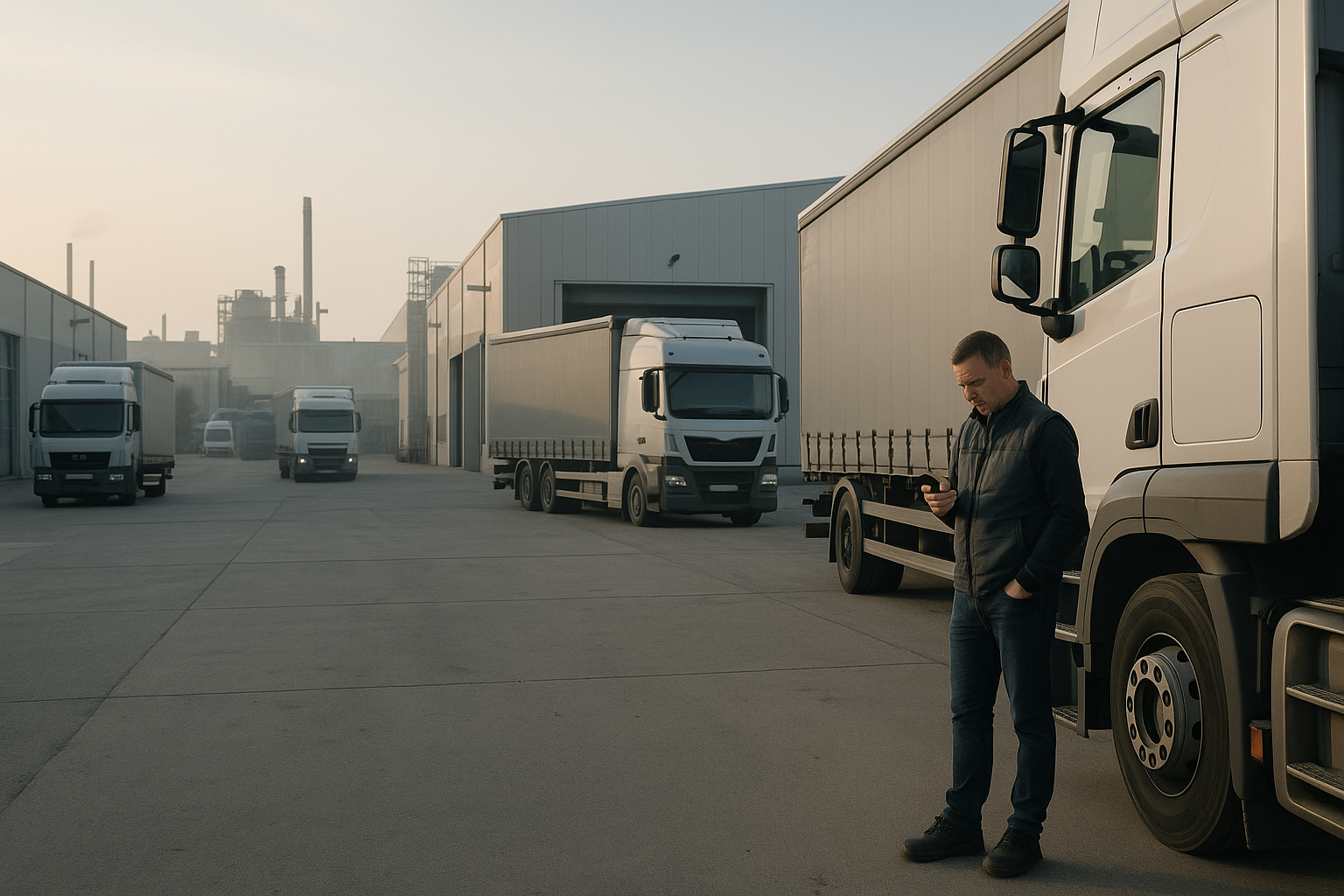
Monday, 06:47. Three trucks are sitting outside the gate — none of them were pre-announced. The fourth, due at 07:00, is somewhere on the A3. Your time-window system shows: all green. This isn’t an exception day. This is structural normalcy across manufacturing plants in the DACH region — and most logistics directors have resigned themselves to it without ever precisely naming why.
The Slot as a False Safety Net
Time-window systems were built to bring order to goods-in. The logic is simple: whoever books, arrives on time. Whoever doesn’t book, doesn’t get in. On paper, it works.
In practice, a booked slot is a promise from a supplier, not a promise from a driver.
That sounds trivial. It isn’t. Between the moment a supplier books a slot and the moment a truck passes your gate, 12 to 48 hours typically elapse — and in that window, responsibility for arrival changes hands multiple times. From supplier to contracted haulier. From haulier to a subcontractor. From the subcontractor’s dispatcher to the driver, who left at 04:30 this morning and hasn’t called anyone since.
The slot in the system remains untouched. It displays: confirmed, 07:00.
FCA Blindness: What This Incoterm Actually Means Operationally
An estimated 40 to 70% of inbound deliveries across the DACH region operate under FCA terms — meaning: the supplier arranges the haulier themselves, goods are at buyer’s risk, but the buyer has no contract with the carrier.
This is logistics routine. The operational consequence is rarely articulated:
You have no direct access to the carrier.
No contract relationship, no portal login, often not even a contact. The haulage company your supplier appointed may know your time-window system — or may not. And even if the haulier has booked a slot: the information that a time window exists needs to reach the driver. Through dispatcher systems, WhatsApp groups, notes in the cab, or handover during route planning.
“The time-window portal creates slots — but not a connection to the person driving the truck.”
This is not criticism of the portals. It’s a description of what they cannot architecturally achieve: they communicate with hauliers, not drivers. And the driver is the only person in the system who knows where they actually are.
An in-house study by Cargoclix — one of the most widely used time-window systems in the German-speaking region — shows that around 50% of users perceive no clearly measurable process improvement from the portal. This is not a malfunction. It’s an indicator of a systemic boundary: portals manage bookings, not arrivals.
Who Actually Knows Where the Truck Is?
Picture the supply chain for a typical inbound shipment: your supplier in Czechia appoints a Polish LTL (less-than-truckload) haulier. They hand off to a German subcontractor for the final leg. The driver — an independent operator with their own truck — received their route the evening before. They may have an address, may have a time window, may have neither.
On your display: slot booked, 07:00, status: confirmed.
Who in this scenario knows at any point between booking and arrival where the truck is? Usually: nobody except the driver.
This is the structural core of the problem. The driver is the last and only information carrier — and simultaneously the person whom no slot system, no ERP, and no pre-advice process directly addresses.
97% of truck drivers in Europe own a smartphone. The technical infrastructure for a direct communication channel would be universally available. Yet goods-in teams at most German industrial plants do not communicate with the driver — they communicate with the haulier’s dispatcher, who then ideally speaks to the driver.
Up to 80% of pre-advices at German plants still run on Excel or email. The pre-advice is information about information: someone shares that someone else will arrive. Whether that someone arrives on time, the pre-advice doesn’t know.
What This Means for Your Yard in Concrete Terms
A goods-in operation with 30 deliveries per day — realistic for a plant with 200 to 500 staff. Around 40% of these deliveries cluster in the first 90 minutes after plant opening. That’s roughly twelve trucks in 90 minutes — one every 7.5 minutes if they arrived evenly.
They never arrive evenly.
Estimate yourself: how many of these twelve trucks actually arrive in the booked 30-minute window? How many arrive 20, 40, 60 minutes early or late? And for how many do you know the ETA ahead of gate arrival — not retrospectively, but with enough lead time for your dispatcher to free up dock space or prioritise another truck?
Every minute a truck waits outside the gate costs. Not just as abstract opportunity cost — but as waiting-time surcharges that hauliers increasingly price into spot-market offers. Plants with a reputation for long waits, poor communication, and no advance notice pay for that through higher freight rates. Sometimes directly, sometimes accumulated over months.
A rough calculation: take 25 deliveries per day, of which 15 show measurable deviation from booked slot. Each deviation creates roughly 15 minutes of coordination effort — a phone call, a rebooking attempt, a wait. That’s 15 × 15 min × 250 working days = 937 hours per year your dispatcher spends on reactive yard coordination — coordination that a slot system never prevented. At an internal rate of €35/hour, that’s five figures annually — just for steering arrivals that the time-window system failed to prevent.
If the Driver Is the Last Link — What Follows?
Most optimisation approaches target the wrong point. Better booking systems, stricter slot rules, escalation processes for no-shows — all of this improves documentation of expectation, not control of reality.
As long as there’s no direct link to the driver, the window between slot booking and gate arrival remains an information vacuum. The morning peak emerges from this vacuum. Waiting times emerge from this vacuum. The coordination effort emerges from this vacuum — the same call cycle, every single day.
The question isn’t: how do I control suppliers better? The question is: how do I get the information that the truck will arrive at 07:20 — before it arrives?
What Direct Driver Communication Changes
Heylog automatically sends the driver a WhatsApp — no app, no registration. They confirm their ETA before arrival. You see it on the dashboard. No phone call, no portal login, no haulier hotline.
This doesn’t fundamentally change the mechanics — FCA remains FCA, the subcontractor chain remains complex. But it closes exactly the information vacuum that lies between slot and gate: reaching the driver directly, the only person who knows where they are.
The Open Question
How many of your current inbound deliveries come from suppliers who arrange the haulier themselves — and for how many of those do you know the true ETA early enough to actively manage your yard?
This isn’t rhetorical. It’s a number most plants don’t know — and one that explains a lot once you work it out.
Frequently Asked Questions
What does FCA inbound blindness mean for goods-in?
Under FCA incoterms, the supplier arranges the haulier. The receiving plant has no contract with the carrier and thus no direct access to tracking portals or driver contact. Estimates suggest this affects 40–70% of inbound deliveries across the DACH region — a structural information vacuum between slot booking and actual gate arrival.
Why doesn’t a time-window portal alone improve on-time delivery?
Time-window portals talk to hauliers, not drivers. The driver — often appointed via subcontractors — receives the time requirement at best indirectly. Cargoclix’s own research shows that roughly 50% of users see no clearly measurable process improvement. The slot secures the booking, not the arrival.
How much coordination effort do late or unannounced trucks actually create?
A rough calculation: with 15 deviating deliveries daily at 15 minutes coordination effort each, you accumulate roughly 937 hours of reactive dispatch work per year. At an internal rate of €35/hour, that’s a five-figure annual cost — purely for steering arrivals that the slot system never stopped.