
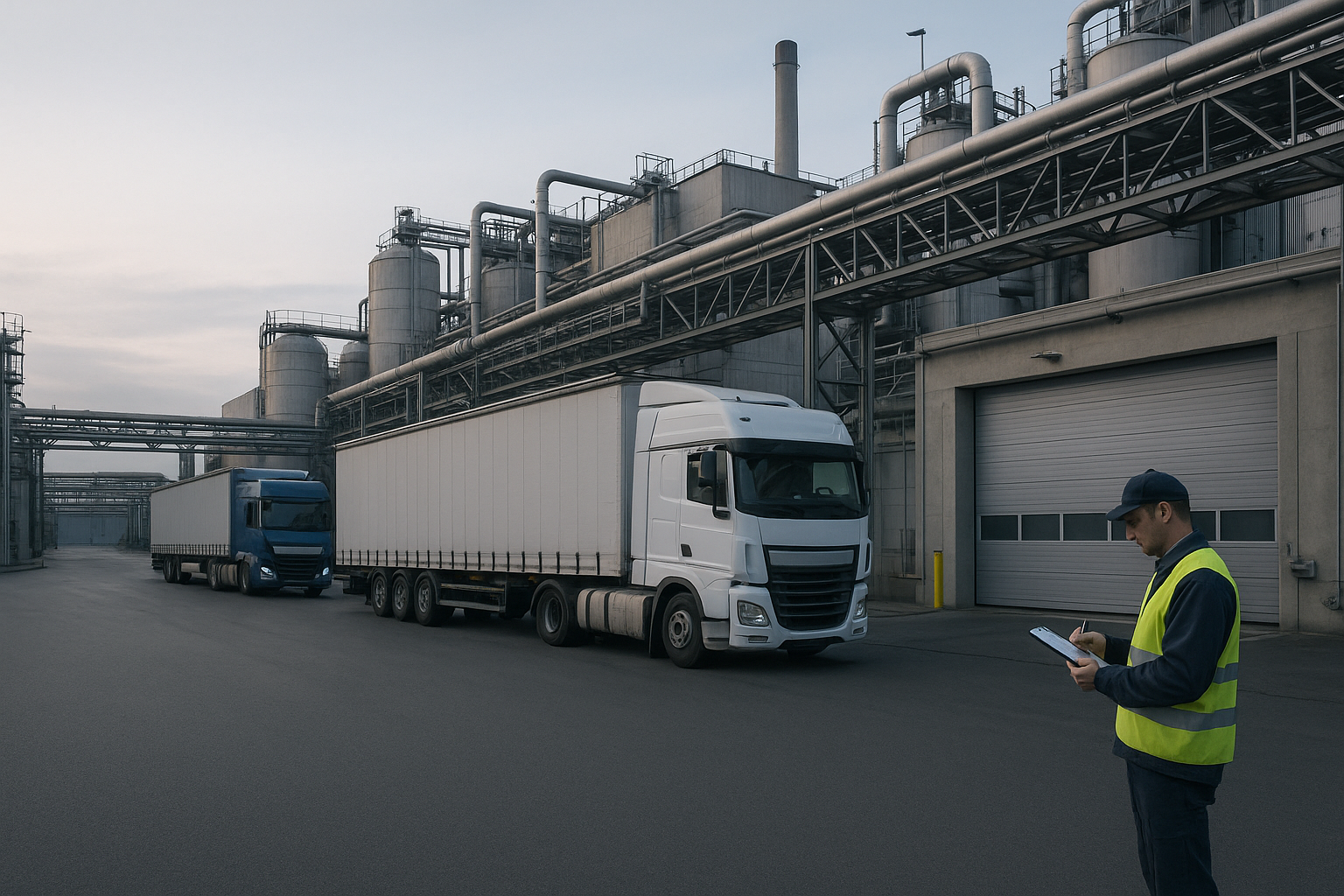
Search for “truck driver apps” in any search engine. You’ll find fuel price comparisons, route planners, driving time trackers, and parking lot finders. Now search instead for “contacting external drivers as a plant” — you’ll get almost nothing. No category, no provider, no established practice. And yet a considerable portion of your daily yard operations plays out in exactly this gap.
The Search Problem Is No Accident
Driver-oriented apps exist because there is clear demand. Drivers need navigation, rest period planning, toll billing. These needs can be digitised because the driver is the direct user. He installs the app. He logs in. He benefits immediately.
The plant is not a user in this system — it is a location where the driver arrives.
That’s why there is no app list for what logistics managers actually need: a channel through which they can speak to external drivers before the truck pulls up to the plant gate. The demand is real, but it has never been formulated as a product category. Not in trade journals, not in search engines, not in software directories.
What Plants Actually Do Today — An Honest Assessment
Ask a logistics manager how he contacts a driver whose arrival he doesn’t yet know. The answers vary, but the pattern is always the same:
- Call the haulier, who calls the driver, who calls back — eventually.
- Email chains with advance notices, which up to 80% of German plants still receive as Excel attachments.
- Hope that the driver has logged into the time-window portal on time.
- Escalation to the dispatch team if the morning traffic jam is already underway.
This is not a team failure. It is the result of a system architecture that treats the driver as a passive recipient — he executes what the booking system, the satnav, and the paper delivery note tell him to do.
Actively reaching out to the driver, asking him when he is arriving, telling him which dock to use — this is not a simple, standardised process in today’s infrastructure. It is improvisation.
The Structure of the Problem: Why the Driver Is the Last Link Nobody Reaches
Picture the chain: Your supplier engages a haulage company. The haulage company engages a sub-contractor. The driver who will stand at your gate tomorrow morning at 06:45 works for that sub-contractor — he has no account in your time-window portal, he does not know your dock numbering, and his dispatcher is still asleep.
Between 40 and 70% of inbound deliveries in the DACH region operate on FCA terms — the supplier organises the transport, and the plant has no direct access to the portal or driver data of the engaged haulier. No login rights, no tracking link, no driver name.
Time-window portals structure planning — they allocate slots, they create order on paper. But they create no communication protocol between plant and driver for the period between slot booking and actual arrival. These 12 to 48 hours are a digital no-man’s land.
The slot system knows when someone is supposed to come. It doesn’t know when he actually arrives — and it cannot ask.
What Happens in the First 90 Minutes — And Why It Determines the Rest of Your Day
Typically, around 40% of all daily inbound deliveries arrive in the first 90 minutes after the plant opens. At 06:00 when the gate opens, by 07:30 half of your expected daily volume is in your yard or waiting outside it.
Take a mid-sized plant with 35 inbound deliveries per day. That’s 14 vehicles in 90 minutes — depending on dock count and unloading time, a real bottleneck. Three docks, two forklifts, one goods-in clerk. And no advance information about which driver actually arrives when.
The maths any logistics manager can do: Take your average driver waiting time during morning peak. Multiply by vehicles at peak. Multiply by the industry standard dwell-time rate — which depending on vehicle type and contract can range from €35 to €80 per hour. Then multiply by 250 working days.
Even on conservative assumptions — 8 vehicles, 20 minutes waiting time, €40 per hour — that comes to almost €27,000 per year in dwell time during morning peak alone. That’s before you factor in the dispatch team making eight unplanned phone calls in the same window.
The App Category That Nobody Built
Let’s look at what exists — and who it was built for.
Driver apps like route planners, parking lot finders, or driving time trackers solve real problems. They are designed with the driver as the end user. He installs, he uses, he benefits.
Time-window portals from the major DACH market providers solve a different real problem: they structure slot allocation between plant and haulier. However, an in-house study by a major portal operator revealed that around 50% of users perceive no real process improvement in day-to-day operations — a sign that slot allocation creates order, but does not fully solve the operational problem on the yard floor. The same study shows: once booking fees reach around €1, haulier-side acceptance drops noticeably.
What is missing is a third category: plant-side communication with the external driver — before, during, and immediately after his arrival.
This category appears in no app list. It has no market owner. It features in no trade journal as a separate section. And that is precisely why nobody searching for a solution to this problem will find it.
What This Category Would Need To Do — Stated From the Plant’s Perspective
When you ask logistics managers what they would expect from such a channel, the same points consistently emerge:
- The driver checks in before he arrives — not when he’s waiting at a closed gate.
- The plant gets a realistic ETA without having to call the haulier.
- Dock assignments or access instructions can be delivered directly.
- No app installation, no portal login for the driver — he is not an office worker.
- Works for drivers who visit your plant only a few weeks per year.
- Works for drivers who do not speak German.
97% of truck drivers have their own smartphone. The channel is there. What is missing is the infrastructure that the plant uses — not the driver.
Why This Blind Spot Emerges Structurally
The reason this category doesn’t exist is as old as B2B software development: you build for the paying user, not the affected party.
The driver is not the customer in any SaaS architecture. He is the end link in a supply chain that either functions or escalates as an operational problem. His smartphone is real. His WhatsApp availability is real. But no traditional software vendor has positioned him as a communication channel for the plant — because the plant was never positioned as the sender in that communication.
Time-window portals position the plant as a receiver of bookings. Driver apps position the driver as an independent actor. Nobody has thought of the plant as an active sender directing the driver.
What This Means for Your Plant
Heylog automatically sends the driver a WhatsApp — he confirms his ETA before he sets off. You see it in the dashboard. No phone calls, no app, no portal login.
This doesn’t solve a routing problem and doesn’t solve a driving hours problem. It solves the specific problem that previously had no product category: the plant as an active communication partner with the external driver in the hours before arrival.
The Real Question
If you wanted to know today when the driver from your supplier in Czechia is going to arrive at your plant — what three steps would you take?
And: how many of those steps are actually built into your planning process?
Frequently Asked Questions
How can a plant contact external drivers before the truck arrives?
Many plants today resort to calling the engaged haulier, who then contacts the driver. More direct approaches use messaging channels like WhatsApp, since 97% of truck drivers have their own smartphone. A structured, plant-side communication channel with the external driver — without app installation or portal login — is not yet an established product category in the DACH market.
Why are time-window portals not enough to reach the driver before arrival?
Time-window portals allocate slots and structure booking between plant and haulier. The period between slot allocation and actual arrival — often 12 to 48 hours — they do not cover communicatively. Moreover, for FCA deliveries (40–70% of DACH inbound), plants often have no direct portal access to the driver data of the engaged haulier.
What does an uncoordinated morning peak at goods-in actually cost?
Typically around 40% of all daily inbound deliveries arrive in the first 90 minutes after plant opening. At 8 vehicles with 20 minutes of unplanned waiting each and an industry-standard dwell-time rate of €40 per hour, that alone adds up to nearly €27,000 annually — not counting the dispatch capacity spent on unplanned follow-up calls during that window.